


Our work

Statewide Systems for Instructional Excellence

We work with states and districts to build instructional systems grounded in evidence, connecting curriculum, leadership, and instructional data to improve teaching and learning at scale.

What we do

Our focus with states and districts.

Improving outcomes starts with improving instruction. We help states and districts build the systems, insight, and leadership required to make high-quality teaching and learning possible at scale.

01

High-quality instructional materials

Framework design, evaluation, and adoption support that connect the Science of Learning, curriculum quality, and instructional improvement.

02

Data for Improving Instruction

Data systems that help leaders identify trends and patterns in teaching and learning, target supports for educators and improve instruction at scale.

03

Leadership development

Leadership development grounded in learning science, instructional improvement, and the systems that enable high-quality teaching and learning.

What the work is built on

Our founding principles.

The promise of high-quality curriculum is realized through leadership. The instructional systems, supports, and implementation conditions leaders create ultimately shape the quality of teaching and learning students experience.

01

Great curriculum needs excellent teachers

The impact of great curriculum depends on great teaching. Leaders must create the systems and supports that enable teachers to deliver high-quality instruction.

02

You cannot measure or correct what you cannot see

System leaders should be able to see trends and patterns in teaching and learning to improve instruction at scale.

03

Teaching is a performance craft

Teachers deserve precise, actionable feedback grounded in evidence of instruction to continuously strengthen their practice.

Trusted by
Maryland State Department of Education Texas Education Agency Education Service Center Region 11 Education Service Center Region 20 The Commit Partnership

Case studies

Statewide Systems for Instructional Excellence

Maryland State Department of Education
Maryland

High-quality instructional materials

A statewide strategy for high-quality instructional materials (HQIM), anchored in a framework for identifying rigorous, grade-level materials that was unanimously adopted by the State Board of Education.

  • Unanimous state board approval for the HQIM framework
  • Framework grounded in building student knowledge and supporting all learners
  • Planning and supports to help districts identify and adopt high-quality instructional materials

Education Service Center Region 11 Texas Education Agency
ESC 11 and TEA

Planning and performance management

A statewide leadership initiative to strengthen planning and performance management capacity among executive leadership teams across 13 Texas Education Service Centers.

  • Performance management capacity across 13 Education Service Centers
  • Systems for managing strategic priorities and organizational performance
  • Aligned routines and progress monitoring tied to instructional goals
Texas Education Agency

Texas Strategic Leadership Academies

A leadership academy for current and aspiring superintendents and district academic leaders focused on building high-impact instructional systems that drive student outcomes, in development with TEA.

  • Research-based instructional practices and instructional models
  • Focused on high-impact instructional systems that drive student outcomes
  • Shared accountability for student success, including students with disabilities

Publications

Our pilot findings.

Instructional quality data, lessons, and insights from the pilot, designed to help education leaders strengthen instructional systems.

Cover of the EdBetter pilot data findings white paper, an illustration of a teacher reading to a circle of children
5,785paired classroom observations
5partner districts
85,000students represented
2,000+classrooms, PreK-3 to high school

All figures are drawn from the published report. Data were collected during the 2025-26 school year and fully de-identified. Findings reflect patterns observed across pilot sites and are not attributable to any individual district.

Top publication

Instructional Improvement Through Curriculum-Aligned Classroom Observation

April 2026 · EdBetter Pilot Data Findings White Paper · 14 pages

States and districts have invested heavily in the promise of high-quality curriculum. But curriculum will not implement itself, and rigorous materials demand rigorous, curriculum-aligned instruction. This paper draws on pilot data from the 2025/26 school year to ask what classroom observation can actually tell system leaders about the distance between the two.

Its central conclusion: the strongest evidence of high-quality instruction was found in classrooms where teachers were intellectually prepared to use materials as intended and supported in translating them into daily instruction. The findings point to the importance of implementation supports grounded in the research base for reading and mathematics, with clear, discipline-specific indicators of instructional quality that help leaders focus improvement efforts where they matter most.

What is inside

  • IScope and nature of the pilot
  • IICase Study: La Joya ISD, districtwide alignment around a shared vision for teaching and learning
  • IIIKey findings for improving instruction, including the role of intellectual preparation, discipline-specific instructional practices, and instructional quality data
  • IVCase Study: The Commit Partnership, coherent cross-system implementation in support of instructional improvement
  • VKey Takeaways

Cite this paper

Hussain, A. (2026). Instructional improvement through curriculum-aligned classroom observation: EdBetter pilot data findings. EdBetter LLC.

Also published

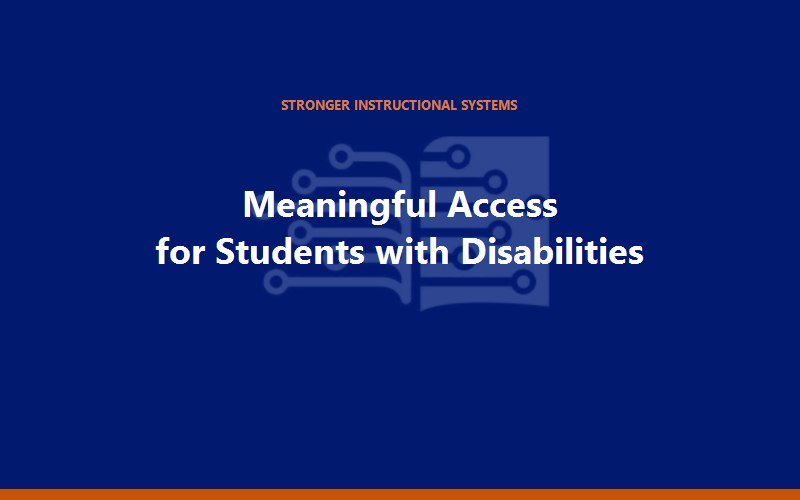
Cover of the EdBetter brief, Meaningful Access for Students with Disabilities

Brief · part one of four

Meaningful Access for Students with Disabilities

Examining how districts can move toward high-quality instructional experiences for students with disabilities.

August 2026 · PDF, 611 KB

Part one of Stronger instructional systems for students with disabilities, a four-part series on designing meaningful access in a high-quality instructional materials environment.
It draws on the pilot data above, and on Specially Designed Instruction resources developed by the Texas Education Agency.

More from EdBetter

Upcoming pieces.

Stronger instructional systems for students with disabilities

Parts two to four of the series.

Streamlining tools and reducing noise on instructional data

Intellectual Preparation

A series.

Get in touch

See what your classrooms are telling you.

A short conversation about your instructional goals, and a walkthrough of how the system works.

Request a demo